


Best Cotton Dress for Women in India : 2026 Trends Guide
By Khushnuma Qazi | Founder, Cotton Culture | June 2026
22+ Years in Indian Apparel & Retail | 52 Stores Across India | www.cottonculture.co.in
Something shifted in Indian fashion around 2022–2023, and I watched it happen right from the shop floor. Women stopped apologising for choosing comfort. A cotton dress stopped being the "safe" option — it became the intentional option. The woman walking into one of our stores wasn't choosing cotton because she had nothing else. She was choosing it because she'd finally decided she was done with fabric that made her miserable by noon.
That shift is now fully visible in how Gen Z and Millennials shop. Both generations grew up with fast fashion and its synthetic promises — bright colours that faded, cuts that puckered, fabrics that clung in the worst possible way during a July commute. The rebound was inevitable. What's interesting is how it landed: not in minimalism, not in neutrals, but in cotton. Breathable, washable, printable, endlessly wearable cotton.
This guide is for every Indian woman — whether you're 22 and building your first real wardrobe, or 40 and simply done tolerating clothes that don't respect the heat. We'll walk through the best cotton dress styles trending in 2026, how to match silhouettes to body types, the real difference between fabrics (yes, rayon is not your friend in summer), and how to build a wardrobe that actually holds up.
Why Every Woman Needs a Cotton Dress: The Comfort-First Psychology
|
✦ Quick Answer Cotton dresses offer unmatched breathability, skin comfort, and wash durability — critical in India's tropical climate. Unlike rayon blends or polyester, 100% cotton regulates body temperature naturally, making it the most practical and healthy fabric choice for everyday wear. |
Let me tell you something I've observed across 22+ years of retail: women don't come back to a brand because of a print. They come back because of how a fabric felt at 4 PM on a long Wednesday. That's the real test.
The conversation around 'repeat-wear wardrobes' has gained real momentum — not just as a sustainability talking point, but as a genuine consumer shift. Women are actively asking: "Will I wear this 50 times, or 5 times?" The answer almost always favours 100% cotton. Here's why:
• Longevity: A well-stitched cotton kurta dress, washed correctly, holds its shape and colour through 100+ washes. Rayon? Often looks washed out after 15.
• Skin health: Cotton's natural fibres don't trap heat against the skin. For women prone to heat rashes — common across coastal India and the Deccan plateau — this is not a small point.
• Wash ease: Cotton survives machine washing without a ceremony. Rayon blends often require cold water hand-washing, or they distort.
• Layering versatility: Cotton takes both block prints and digital prints beautifully. It accepts dyes more evenly, which is why handblock printed cotton dresses look richer and last longer than the same print on a synthetic fabric.
|
🧵 Founder's Retail Insight — Khushnuma Qazi After running Cotton Culture across 52+ stores in India, one thing never changes: the women who become loyal customers are the ones who first touched our fabric and said, 'This is different.' The feel is the first sale. Everything else — the print, the cut — confirms it. |
There's also a generational confidence at play. Younger Indian women today — particularly those in Tier-2 cities like Nashik, Kolhapur, Surat, and Indore — are less influenced by what's "trending online" and more by what genuinely works for their daily routine. Cotton, with its versatility and reliability, fits that expectation perfectly.
Best Cotton Dress Styles Trending in 2026
|
✦ Quick Answer In 2026, the top cotton dress trends for Indian women include A-line midi dresses, shirt dresses, floral block prints, indo-western fusion cuts, and solid everyday dresses with pockets. These styles balance comfort with contemporary Indian aesthetics. |
Not every cotton dress is built the same. 2026 has been particularly interesting because the trends aren't chasing Western runways — they're emerging from Indian street style, regional craft traditions, and the very practical needs of a woman who commutes, manages a full day, and still wants to look put-together.
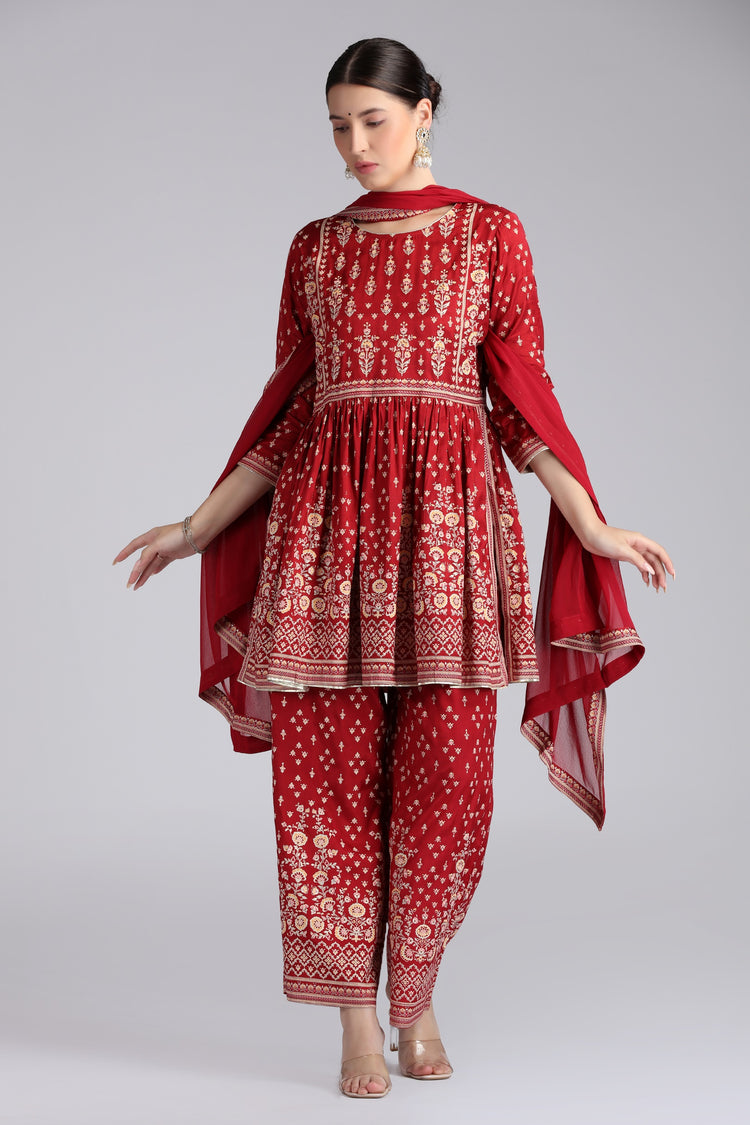
A-Line Cotton Dresses — The Foundation Silhouette
The A-line remains the most universally flattering silhouette in Indian women's ethnic wear, and 2026 is no different. The cut flares gently from the waist or hips, which means it doesn't cling — a critical consideration in Mumbai monsoon humidity or the dry heat of a Jaipur afternoon.
In cotton, A-line dresses carry prints beautifully. The slight volume at the hem allows handblock prints and geometric patterns to read clearly without distortion. For women who prefer not to layer, an A-line cotton dress with a round neck or V-neck is a complete outfit on its own.
Midi Cotton Dresses — The Length That Works Everywhere
The midi silhouette — falling between the knee and ankle — has overtaken maxi as the preferred length for Indian women in urban settings. It's practical: the hem stays away from flooring dirt during temple visits or street markets, while still offering the modesty most women prefer in mixed professional settings.
In mulmul cotton or lightweight cambric, a midi dress stays light enough for summer but has enough structure to look intentional. This is the format we see selling most reliably in cities like Pune, Bengaluru, and Hyderabad — where outdoor heat and indoor air conditioning create a thermal challenge that only breathable fabric can solve.
Solid Cotton Dresses — Underrated, Always Wearable
Solid cottons have had a quiet renaissance. Women who spent years chasing prints are now investing in solid earth tones, deep teals, and warm terracottas that photograph well and pair with everything. A solid cotton dress in mid-weight slub cotton is one of the most versatile wardrobe investments you can make — it works with a juttis and a dupatta for festive, or simple sandals for casual.
What's notable: in our stores across Southern India, we've seen a clear lean toward deeper, richer solids — indigos, bottle greens, mustard. In the North, pastels and ivory move faster. Both are cotton. The geography just shapes the colour preference.
Shirt Dresses — Office-Ready, Effortlessly Styled
The cotton shirt dress entered Indian wardrobes through workwear and stayed because of its adaptability. A collared, button-down cotton dress in a solid or subtle stripe reads professional, works in most office environments, and transitions to a dinner out with a belt and heels.
For Indian summers specifically, a half-sleeve or sleeveless shirt dress in 100–120 GSM cotton is ideal — light enough to not trap heat, structured enough to not look crumpled. This is one of the few ethnic-adjacent styles that works seamlessly in corporate settings without requiring a dupatta or jacket overlay.
Floral and Block Print Cotton Dresses — India's Signature
India's textile heritage is inseparable from its floral and handblock print tradition. In 2026, block prints are no longer niche — they're mainstream, and for good reason. A hand-crafted block print on cotton ages beautifully. The print deepens slightly after washing, taking on a character that machine prints never develop.
At Cotton Culture, our printed cotton dresses consistently lead in repeat purchases — not just because of how they look fresh, but because of how they look after a year. Customers return and say the fabric looks better. That's the quality of reactive dyes on 100% cotton, and it's genuinely something synthetic fabric cannot replicate.
Cotton Dresses With Pockets — Non-Negotiable in 2026
If there's one feature that defines modern Indian women's expectations, it's pockets. This is not a joke, and it's not a small detail. The demand for functional pocket placement in ethnic wear has grown sharply, particularly among women aged 25–35 who carry a phone, keys, and possibly a coin purse without wanting to carry a bag.
A cotton dress with well-placed side or patch pockets now commands a significant premium in customer preference at our stores. It's a small design decision that tells a woman: this outfit was designed for how you actually live.
Indo-Western Cotton Fusion — The 2026 Sweet Spot
The indo-western fusion segment — think tiered cotton dresses with mirror-work detailing, asymmetric hemlines with contrast stitching, or kaftan-style cuts with ethnic prints — is growing fastest among women in the 20–30 age bracket.
These styles work because they don't force a choice between "ethnic" and "contemporary." A cotton fusion dress worn with statement earrings reads ethnic for family occasions; the same dress with sneakers reads streetwear-adjacent. That contextual flexibility is exactly what younger Indian women are looking for.
Which Cotton Dress Works Best for Your Body Type?
|
✦ Quick Answer For petite frames, opt for midi A-line or knee-length dresses to elongate proportions. Taller women can carry both maxi and mini lengths. For fuller figures, empire waist or wrap-style cotton dresses provide comfortable structure without restriction. Avoid clingy cuts in any silhouette. |
This section is not about rules. It's about understanding how silhouettes interact with your proportions, so you spend less time returning orders and more time actually wearing your clothes. After watching thousands of women try on dresses across our stores, here's what I know works:
|
Body Type |
Best Silhouette |
Fabric Weight |
What to Avoid |
|
Petite / Short |
Knee-length A-line, empire waist |
Lightweight mulmul or cambric |
Floor-length maxi (overwhelms) |
|
Tall / Lean |
Maxi, shirt dress, midi |
Structured slub cotton |
Very short, shapeless cuts |
|
Curvy / Fuller |
Wrap style, empire waist, flared |
Mid-weight cotton (120–140 GSM) |
Bodycon or very fitted cuts |
|
Athletic / Straight |
Tiered, ruffled hemline, cinched waist |
Any cotton weight |
Shapeless box cuts |
|
Petite + Curvy |
Midi A-line with defined waist detail |
Soft cambric |
Wide-leg pant combos (shorten legs) |
The single biggest mistake women make is choosing a maxi cotton dress in a very light, sheer mulmul because they love the print — and then not accounting for how unstructured it becomes in the wind, or how visible the lining seams are in bright sunlight. Always check the GSM (grams per square metre) of the fabric. For unlined dresses, 120 GSM and above gives sufficient opacity.
The Fabric Masterclass: Cotton vs. Mulmul vs. Linen vs. Rayon
|
✦ Quick Answer Yes — 100% cotton outperforms both rayon and linen for Indian climate wear. Cotton absorbs moisture naturally, dries faster than linen, and unlike rayon (a semi-synthetic), doesn't trap body heat. Cotton-poly blends are the worst choice for hot, humid conditions. |
This is the section most brands skip because fabric science doesn't photograph well. But understanding what your dress is actually made of is the single most important purchase decision you can make — more than print, more than price.
|
Fabric |
Breathability |
Moisture Absorption |
Durability |
Best Use in India |
Verdict |
|
100% Cotton |
Excellent |
High (natural fibre) |
High (100+ washes) |
All-day wear, all regions |
✅ Best overall |
|
Mulmul Cotton |
Exceptional |
Very high (loose weave) |
Medium (delicate) |
Summer, coastal humidity |
✅ Best for heat |
|
Linen |
Very good |
High |
High (stiffens over time) |
Dry heat (Delhi, Jaipur) |
✅ Good alternative |
|
Rayon / Viscose |
Poor |
Low (semi-synthetic) |
Low (distorts when wet) |
Avoid in humid climates |
❌ Not recommended |
|
Cotton-Poly Blend |
Poor |
Very low |
Medium |
Avoid in Indian summer |
❌ Avoid entirely |
|
Slub Cotton |
Good |
High (natural texture) |
Very high |
Office, travel, year-round |
✅ Great for structure |
Let me be direct about cotton-poly blends. They exist because polyester reduces manufacturing cost and adds wrinkle resistance. What it takes away is breathability. Polyester is a plastic fibre. It traps heat against the skin. In a city like Nagpur, where summer temperatures hit 45°C, a cotton-poly dress is physically uncomfortable by 11 AM. There's no elegant way to say it: for Indian summers, poly blends are the enemy.
Rayon gets marketed as "soft" and "breathable." It's neither, reliably. Rayon is a semi-synthetic derived from wood pulp — it feels cool off the rack but traps heat in wear. When wet (from sweat, or from the Mumbai rains), it loses its shape. The drape that looked elegant in the store becomes clingy and heavy after an hour outdoors. For coastal humidity — Chennai, Kochi, Mumbai — rayon dresses are genuinely impractical.
Mulmul, on the other hand, is one of India's great fabric contributions to the world. Mulmul cotton is a loosely woven, very fine cotton that allows air to circulate freely. It's the reason traditional Indian dress was always so well-suited to the subcontinent's climate — our ancestors understood fabric science long before GSM ratings existed. For a summer cotton dress, mulmul is exceptional — just ensure it's lined or has sufficient GSM for modesty.
|
🧵 Founder's Retail Insight — Khushnuma Qazi We have never compromised on fabric composition at Cotton Culture, and that's not marketing copy — it's a business decision. Women who buy a rayon dress that falls apart in three months don't come back. Women who buy our cotton kurta sets and wear them for three years become brand advocates. The fabric is the relationship. |
Cotton Dresses for Every Lifestyle: Office, College, Travel & Daily Life
|
✦ Quick Answer For office, choose structured shirt dresses or A-line midis in solid or subtle prints. College students benefit from knee-length floral or indo-western styles. For travel, lightweight mulmul or cambric A-line dresses are ideal. For daily errands, any mid-weight cotton dress with pockets works best. |
A cotton dress is not a single-occasion garment — that's the entire point. The real value of investing in quality cotton is how far a single piece travels through your week without demanding attention or maintenance.
The Office: Structure Without Suffering
The commuter struggle is real and deeply underestimated in Indian fashion conversations. A woman who takes a crowded Mumbai local at 9 AM and emerges into a humid platform — then walks into an air-conditioned office at 10°C below outside temperature — needs fabric that functions in both environments. Cotton does this. Polyester does not.
For office wear, a cotton shirt dress or A-line midi in a solid deep colour — navy, bottle green, or rust — with minimal detailing reads professional without requiring a separate jacket. Pair with block-heeled sandals and a structured tote. The dress doesn't wrinkle dramatically in transit the way linen does, and it doesn't look crumpled after you've been sitting for four hours the way rayon does.
College: Expressive Without Being Uncomfortable
For women in their late teens and early 20s, cotton dresses with bold prints, tiered hemlines, or contrast detailing hit the right balance between expressive and practical. A knee-length block print cotton dress worn with sneakers and a denim jacket works on campus from 9 AM to 6 PM without a single wardrobe adjustment.
The indo-western fusion styles — particularly asymmetric hemlines and contrast piping on cotton dresses — have strong traction in college settings because they're recognisably Indian without being what some younger women call "too ethnic for Tuesday."
Travel: The Mulmul Advantage
Travel puts the most stress on any outfit. It has to survive cramped seats, humidity variations, outdoor walking, and multiple days in a bag — sometimes all of these. The case for mulmul or lightweight cambric cotton dresses for travel is overwhelming.
A 120 GSM cotton dress in a midi A-line or wrap cut takes up minimal bag space, shakes out without requiring ironing, and works across contexts — a temple visit, a heritage walk, an evening dinner. This is why our online orders spike particularly around October–March, when most Indian leisure travel happens. Women plan their wardrobes around cotton.
Daily Errands: The Dress That Just Works
There is a specific kind of cotton dress that Indian women have perfected over generations — the all-day errand dress. Not dressy, not casual, not ethnic in a formal sense. Just right. Deep side pockets, a neckline that doesn't require constant adjustment, a hemline that allows easy movement — in cotton that breathes through a morning vegetable market run and a school pickup at 1 PM and a quick evening walk.
This is the dress that gets worn 200 times, not 20. It's also, quietly, the most important item in any Indian woman's wardrobe — and it almost always comes back to pure cotton.
The Cotton Culture Perspective: What 22 Years in Retail Teaches You
|
✦ Quick Answer Cotton Culture brings 22+ years of retail expertise, 52+ self-managed stores across India, and a strict cotton-first fabric philosophy. Every design is tested against India's climate realities — from coastal humidity to desert heat — making it a trusted source for quality everyday cotton wear. |
Running 52+ self-managed stores across India — from Navi Mumbai's Airoli to Kolhapur's Rajarampuri, from Ghatkopar to Tier-2 cities in Maharashtra — teaches you things about Indian women's fashion preferences that no trend report can capture. You learn them one customer at a time.
Here are some of the patterns we've observed that I think every woman shopping for cotton dresses should know:
• Print preference is regional: Customers in Southern India consistently prefer darker, richer prints — deep indigo block prints, saturated florals, jewel tones. In North and Central India, pastels and ivory move significantly faster, particularly in the March–June window before peak summer. Neither is better; both are valid. Knowing your regional aesthetic helps you shop smarter.
• Size consistency matters more than trends: The most consistent feedback we receive — across platforms and stores — is about sizing accuracy. Women will return to a brand indefinitely if the size 14 they bought two years ago fits the same as the size 14 today. This is operational discipline, not design creativity. But it builds more loyalty than any seasonal trend.
• Cotton investment is generational: We see mothers and daughters shopping together regularly, with the mother actively steering the daughter toward pure cotton over synthetic blends. This is not nostalgia — it's experiential knowledge. Women who've worn good cotton for 20 years understand its value intuitively.
• Festive cotton is growing: There's a genuine shift happening — festive-occasion dresses in cotton are growing as a category. Five years ago, a customer might have switched to a synthetic blend for Diwali. Now, she wants a handblock printed mulmul dress or an embroidered cotton kurta dress — something that feels celebratory but doesn't make her regret wearing it two hours in.
|
🧵 Founder's Retail Insight — Khushnuma Qazi The most significant retail observation from the last three years: women are spending slightly more per piece, but buying fewer pieces. They're not scaling down their wardrobes — they're scaling up their standards. That's exactly the market Cotton Culture was built for. |
At Cotton Culture, our fabric sourcing has remained consistent with the same philosophy since we opened our first stores in 2010: pre-washed, pre-shrunk cotton that doesn't deceive the customer after the first wash. What you feel in the store is what you get in six months. That commitment — boring to describe, crucial to live — is what brings women back across 52+ locations.
Frequently Asked Questions: Cotton Dresses for Women in India
Q: Is cotton better than rayon for a dress in Indian summers?
Yes, definitively. Rayon is a semi-synthetic fibre that feels cool initially but traps body heat and loses shape when wet. 100% cotton allows natural air circulation, absorbs moisture effectively, and maintains its structure through a full day in humidity. For Indian conditions, cotton is the only reliable choice for all-day comfort.
Q: What is the best cotton fabric for a dress in hot and humid weather?
Mulmul cotton — a finely woven, loosely structured cotton — is best for coastal humidity and peak summer heat. For drier heat regions like Rajasthan and central India, cambric cotton at 100–120 GSM offers a good balance of breathability and structure. Both outperform all synthetic alternatives in tropical conditions.
Q: How do I care for a cotton dress to prevent shrinkage?
Choose pre-washed and pre-shrunk cotton garments — this is the most important step, and happens before purchase. For washing, use cold water on a gentle machine cycle or hand wash. Avoid tumble drying; air dry in shade to preserve both colour and shape. A quality cotton dress treated this way will last 100+ washes without significant shrinkage.
Q: Are cotton dresses suitable for office wear in India?
Absolutely. Cotton shirt dresses and A-line midi dresses in solid or subtle prints work well in most Indian office environments. Choose slub or structured cotton over mulmul for office settings — it holds its shape through a full workday and handles the transition between outdoor heat and air-conditioned spaces without losing its appearance.
Q: What GSM of cotton is best for a dress?
For summer dresses meant to be worn without a lining: 120–150 GSM is ideal. Below 100 GSM becomes too sheer for most daily contexts without careful underlining. For structured shirt dresses or office wear, 150–180 GSM provides the right body and crease resistance. Heavier cotton (180+ GSM) is better suited for structured pants or jackets, not lightweight dresses.
Q: What cotton dress length is best for petite Indian women?
A knee-length A-line or empire-waist dress is most flattering for petite frames — it elongates the silhouette without overwhelming the figure. Midi length also works if the dress has a defined waist detail (belt, cinched seam, or tie). Maxi dresses tend to shorten the perceived leg line unless the print and cut are very carefully chosen.
Q: Are cotton dresses good for travel in India?
Cotton dresses — especially in mulmul or lightweight cambric — are among the best travel clothing choices. They pack compactly, shake out without ironing, dry quickly if washed, and transition comfortably between varied climates. A midi A-line cotton dress is particularly practical for travel because it works across temples, street markets, restaurants, and heritage sites without being inappropriate in any context.
Q: What is the difference between a cotton kurta dress and a Western-style cotton dress?
A cotton kurta dress typically has ethnic detailing — mandarin collar, side slits, block print, or embroidery — and is worn with or without a dupatta. It sits within the ethnic-wear category and carries Indian aesthetic codes. A Western-style cotton dress uses international silhouettes (shirt dress, wrap dress, sundress). Indo-western cotton dresses blend both — ethnic fabric and prints with contemporary cuts — and represent the fastest-growing segment in Indian fashion today.
Q: Is it worth buying branded cotton dresses vs. unbranded?
The key differentiator in branded cotton wear is fabric consistency and garment construction quality. An unbranded dress may use a similar cotton blend but cut corners on pre-washing, stitching tension, or dye quality — leading to shrinkage, colour bleed, or seam failure. With established brands, you're paying for process discipline, not just a label. That discipline is what makes a dress last 3 years instead of 3 months.
Q: Suit set vs. cotton dress — which is better for summer?
Both have merit. A cotton suit set (kurta + palazzo or straight pant) gives more layering flexibility and works better in formal contexts. A cotton dress is faster to put on and removes the question of coordination. For women who prefer zero-effort dressing — one piece, complete outfit — a cotton dress wins for daily wear. For occasions requiring more formality or layering, a suit set offers greater versatility.
Building a Cotton-First Wardrobe: Where to Start
If you're reading this and thinking about actually reorganising your wardrobe around quality cotton, start with three pieces rather than a full overhaul: one A-line midi dress in a print you love, one solid cotton dress in a colour that works with everything you own, and one shirt dress or structured cotton dress for occasions that need something more defined.
These three will cover the majority of your weekly wardrobe needs — work, casual, and a light festive — in fabric that India's climate was built for. Add gradually. Buy less, buy better. The wardrobe that serves you well is always smaller and more intentional than you expect.
At Cotton Culture, every piece we design starts from that same principle: made for the real India, made for the real Indian woman, made to last. Explore our latest cotton dress collections — or walk into any of our 52+ stores across the country and feel the difference for yourself.
About the Author
Khushnuma Qazi is a fashion entrepreneur and Founder of Cotton Culture, a homegrown Indian women's apparel brand with 52+ stores across India. With over 22 years of experience in apparel manufacturing, design, and retail expansion, she writes on Indian fashion trends, cotton-first apparel, sustainable practices, and consumer-centric retail strategies. Her insights are grounded in real-world retail experience and evolving customer preferences.
LinkedIn: https://www.linkedin.com/in/khushnuma-qazi-b61852259/


