


Top Kurta Designs Trending in India Right Now: Styles Women Are Actually Wearing
By Khushnuma Qazi | Founder, Cotton Culture | 22+ Years in Indian Apparel & Retail | 52 Stores Across India
For most of the last decade, ethnic wear existed in two distinct categories in Indian women's wardrobes: the daily, barely-thought-about cotton kurta, and the special-occasion outfit pulled out twice a year. That binary is breaking down. Top kurta designs trending in India today are refusing that old separation — women are choosing styles that are festive enough to feel considered, but comfortable enough to wear every single week.
I've watched this shift happen slowly, then all at once. Across our 52 Cotton Culture stores nationwide, the conversations at the trial room have changed. Women aren't asking "Is this appropriate for a wedding?" anymore. They're asking, "Can I wear this to work on Monday and a pooja on Sunday?" That question — equal parts practical and style-conscious — is driving everything we see in ethnic wear right now.
What follows is not a trend forecast built from runway data. It's a ground-level read of what's actually moving off shelves, what fabrics are earning repeat purchases, and which silhouettes are showing up in every city from Mumbai to Mysore. I'll also be direct about why certain designs outperform others — not just aesthetically, but functionally, across India's punishing climate range.
At a Glance: Top 10 Kurta Design Trends in India (2025-2026)
|
⚡ Quick Answer: Top kurta trends India 2026 The leading kurta designs trending in India right now are straight cut cottons, A-line silhouettes, short kurtis paired with jeans, co-ord sets, Anarkali styles, asymmetrical hemlines, printed palazzo sets, Chikankari-inspired work, fusion crop kurtis, and minimalist block-print designs. |
• Straight Cut Kurta — the professional's go-to; clean lines, all-day wearability
• A-Line Kurta — universally flattering silhouette with strong seasonal performance
• Short Kurti (below hip) — Gen Z resurgence, jeans-first styling, campus-to-café
• Cotton Co-ord Sets — India's new power suit; travel, brunch, and festive-casual
• Anarkali Kurta — re-entering everyday wardrobes via lightweight cotton versions
• Asymmetrical Hemline Kurta — high-low cuts adding movement without effort
• Printed Palazzo Kurta Set — festive comfort; the post-lockdown favourite that stayed
• Chikankari-Style Embroidered Kurta — artisanal detailing gaining traction in premium casual
• Crop Kurti + High-Waist Ethnic Bottom — fusion silhouette; urban, youthful, occasion-flexible
• Block-Print Minimalist Kurta — sustainable, craft-forward, growing among 25–40 demographic
Why Certain Kurta Designs Are Trending More Than Others
|
⚡ Quick Answer: Why are some kurta designs more popular? Trending kurta designs share three traits: they perform well in India's climate (especially cotton's breathability advantage over synthetics), they work across at least two occasions, and they require minimal styling effort. Comfort-first fashion and Gen Z's fusion sensibility are the two biggest drivers right now. |
The Comfort-First Shift in Indian Fashion
The pandemic didn't create comfort dressing — it just made it undeniable. Indian women, who had already been gravitating toward wearable ethnic wear over the previous five years, lost their tolerance for uncomfortable clothing almost overnight. But here's what's interesting: comfort-first fashion in India isn't about loungewear or shapeless clothing. It's about garments that look put-together but feel effortless.
A straight cut kurta in pre-washed cambric cotton does both. So does a well-constructed A-line in slub cotton. The trending designs right now are not the most embellished or the most minimal — they're the ones that earn a high cost-per-wear ratio without demanding anything extra from the woman wearing them.
|
🏪 Founder's Retail Insight — Khushnuma Qazi Across our stores — including the R City Mall, Ghatkopar outlet (rated 4.1/5 across 117 reviews) and our Rajarampuri, Kolhapur store (rated 4.9/5) — the single most consistent customer comment we receive is: "I keep coming back because I don't have to think about it." That's the clearest indicator of a trend with real longevity. |
The Cotton Factor: Survival Fabric for the Indian Climate
This isn't a marketing line. Cotton — pure cotton and quality cotton blends like cambric, mulmul, and slub cotton — is genuinely functional in a way synthetics aren't, especially in the Indian context.
Consider the geography: Mumbai's coastal humidity sits at 80–90% from June to September. Delhi summers hit 44°C with dry, intense heat. Bangalore offers a temperate working environment but still demands breathable fabric for long office days. A kurta that looks acceptable at 9 AM in a synthetic rayon or polyester blend has already become uncomfortable by noon in any of these cities. Cotton absorbs moisture before it registers as dampness on the skin — up to 27 times its own weight — and allows air circulation that synthetic fibres structurally prevent.
|
Fabric |
Mumbai Humidity |
Delhi Dry Heat |
Bangalore Office |
|
Pure Cotton |
✅ Excellent — wicks and breathes |
✅ Excellent — absorbs sweat fast |
✅ Excellent — light and professional |
|
Cambric Cotton |
✅ Very Good — fine weave, breathes well |
✅ Very Good — crisp look all day |
✅ Very Good — structured silhouette |
|
Mulmul / Voile |
✅ Best — near-zero weight |
✅ Best — maximum airflow |
⚠️ Good — too sheer for formal use |
|
Rayon / Polyester |
❌ Poor — traps moisture |
❌ Poor — raises body temp |
⚠️ Passable for air-conditioned spaces only |
Gen Z's Influence: Fusion, Minimalism, and the End of Occasion-Dressing
Women between 18 and 26 are the fastest-changing segment in Indian ethnic wear right now, and their preferences are rippling upward into the 30s and 40s demographics. Gen Z isn't abandoning kurtas — far from it. They're restyling them. A short kurti worn over straight-cut jeans with white sneakers isn't a casual compromise; it's a deliberate aesthetic choice. A printed co-ord set paired with a structured bag isn't festive wear — it's an everyday outfit elevated.
What Gen Z has done for the kurta market is collapse the occasion hierarchy. In our stores, we see 21-year-olds buying the same A-line kurta sets that 38-year-olds are reaching for. The design works because it doesn't demand an occasion. It just works.
Top Kurta Design Trends: Deep Dives
1. Straight Cut Kurta Design: The Professional's Uniform
|
⚡ Quick Answer: What is a straight cut kurta? A straight cut kurta features a consistent width from shoulder to hem with minimal flare. Available in lengths from mid-thigh to knee, it creates a lean, structured silhouette that reads as formal or smart-casual depending on fabric and print choice. Ideal for office and daily wear. |
The straight cut kurta has become, without any formal declaration, the professional ethnic uniform for Indian working women. It's not flashy, it doesn't demand accessories, and it doesn't negotiate with your body type — it simply works.
What's driving the current surge isn't novelty; it's refinement. The straight cuts trending right now are better cut than they were five years ago. Side slits are positioned higher for movement. Necklines are more considered — mandarin collars and V-necks replacing generic round necks. The fabric mix has shifted decisively toward pure cambric and slub cotton, which hold their shape through a 10-hour workday without pulling, pilling, or creasing beyond recovery.
Why it's trending: Corporate dress codes across India have softened significantly post-2020. Ethnic wear is now acceptable in most formal office environments, and the straight cut kurta navigates that space perfectly — professional enough for a client meeting, comfortable enough for a commute in August.
Styling tip: Pair a knee-length straight cut in a muted print (classic Ajrakh-inspired geometric or a subtle digital floral) with tapered pants and block-heeled mules. This combination works from a 9 AM call to a 7 PM dinner without a wardrobe change.
Climate suitability: Exceptional. Cambric cotton straight cuts perform in both Mumbai humidity and Delhi heat. In Bangalore, the slightly heavier slub cotton version keeps its structure beautifully in temperate, air-conditioned office settings.
|
🏪 Founder's Retail Insight — Khushnuma Qazi Observations across our 52+ stores show that professional women are consistently pivoting from heavily embellished styles to printed cotton straight cuts for 10-hour workdays. The repeat purchase rate on straight cut kurtas in corporate-adjacent areas like Airoli (Navi Mumbai) is among our highest across all categories. |
2. A-Line Kurta Design: Built Around Body Neutrality
|
⚡ Quick Answer: What is an A-Line kurta? An A-line kurta is fitted or semi-fitted at the shoulders and bust, then flares gradually outward toward the hem — resembling the letter A. The silhouette skims the body without clinging, making it inclusive across body types. It is one of the most universally recommended styles in Indian ethnic wear. |
If there's one silhouette that refuses to fade from India's ethnic wear market, it's the A-line. It has been trending, in some form, for over a decade — and that's not coincidence. The A-line works because it doesn't fight the body; it moves with it.
The current version trending across Cotton Culture's range and the broader market is softer than the heavily structured A-lines of 2015–2018. Contemporary cuts use lighter cotton-blend fabrics that drape rather than project, giving the silhouette a fluidity that reads as modern. Embellishment has dialled down — a well-placed gota border, a single yoke print, or an embroidered neckline is sufficient. The rest of the kurta stays clean.
Why it's trending: The body-neutrality conversation in Indian fashion has real legs, and the A-line has become its default silhouette. Across all age groups and body types in our stores, A-line kurtas generate the fewest exchanges and the fewest fitting complaints. That's data.
Styling tip: A mid-length A-line (falling to mid-calf) in a mulmul or voile cotton pairs beautifully with slim palazzos or straight-leg churidar. For a contemporary touch, try it with wide-leg trousers in a contrasting solid. The flared hem creates visual balance regardless of the bottom chosen.
Climate suitability: Excellent in high-humidity environments like Mumbai and Kochi — the flare promotes air circulation around the lower body. In drier climates, the slightly heavier cambric version holds shape well without sticking.
3. Short Kurti Design: The Jeans-First Resurgence
|
⚡ Quick Answer: Are short kurtis trending in India in 2025? Yes. Short kurtis (hitting mid-thigh or just below) are experiencing a strong resurgence, driven primarily by Gen Z's preference for pairing ethnic tops with jeans, leggings, or shorts. The trend is particularly strong in Tier-1 cities and among college-going women aged 18–26. |
Short kurtis never really disappeared — but they're back with a different attitude. Where the short kurti of the early 2010s was often an afterthought (a regular kurta that happened to be cut shorter), today's short kurti is a designed piece. The hem length is deliberate. The proportions account for the fact that it will be worn over jeans, not salwar.
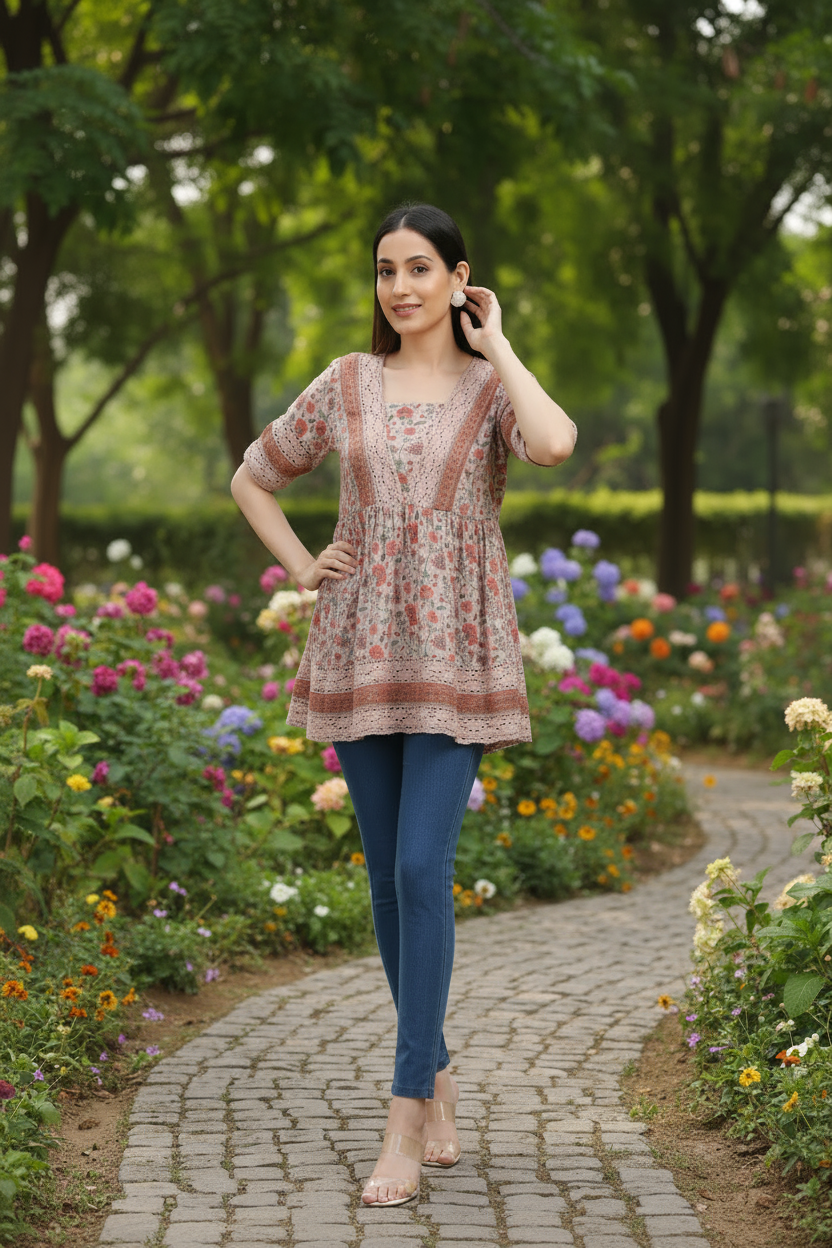
The styling language has also shifted. Today's short kurti pairing tends toward high-waist wide-leg jeans or straight-cut denims, not the slim-fit jeans of a decade ago. White sneakers or chunky kolhapuris have replaced heeled mojaris as the dominant footwear choice. The result is an outfit that reads as effortlessly contemporary while retaining a clear ethnic design vocabulary — Ajrakh prints, block motifs, or classic Lucknawi-inspired embroidery on a casual cotton base.
Why it's trending: Fusion wear is the dominant styling mode for urban Indian women under 30. A short kurti offers ethnic character without requiring the full coordination of a salwar set. It's versatile enough to belong to both "ethnic" and "casual" categories simultaneously — a wardrobe efficiency that resonates strongly.
Styling tip: A printed cotton short kurti (mid-thigh length) with high-waist straight jeans and a sling bag is the current campus-to-café uniform. For an evening elevation, swap jeans for tailored palazzo pants in a matching or complementary solid, and the same kurti reads as a complete ethnic set.
Climate suitability: Ideal for urban heat. Shorter hemlines reduce fabric weight and allow easier movement in crowded, humid public spaces — metros, college campuses, markets. Cotton short kurtis perform well in all Indian climate zones.
4. Cotton Co-ord Kurta Sets: India's New Power Suit
|
⚡ Quick Answer: Why are co-ord sets trending in Indian ethnic wear? Co-ord sets — matching kurta and bottom sold as a designed pair — have become the dominant trend in Indian women's ethnic wear because they solve the 'what to wear' decision instantly while appearing styled and considered. They work across occasions from casual outings to festive events. |
The co-ord set is doing something remarkable in India's ethnic wear market: it's becoming the default. Not the special-occasion choice, not the festive splurge — the default. This is a significant shift, and it's being driven by a specific kind of consumer intelligence.
Modern Indian women are time-poor and style-aware. A co-ord set solves a real daily problem: it delivers a complete, cohesive outfit without requiring the mix-and-match judgment that most women — however stylish — don't always have the bandwidth for at 7:30 AM on a workday. The fact that it also looks deliberately put-together is the functional cherry on top.
At Cotton Culture, co-ord sets have become one of our strongest performing categories across both physical stores and online channels (Myntra, AJIO, Amazon, Flipkart). The prints trending right now lean toward geometric digitals, Ajrakh-inspired motifs, and soft florals — not the maximalist, festival-specific prints that dominated five years ago. The palette has also shifted: terracotta, sage green, dusty rose, and deep indigo are outperforming the traditional brights.
Why it's trending: The power of the co-ord lies in its transferability across occasions. A cotton printed co-ord set worn to brunch Saturday morning can be worn to a Diwali gathering Saturday evening with a dupatta added. That occasion-bridging functionality is driving purchase decisions in every age bracket.
Styling tip: Resist the temptation to add a print-on-print dupatta to a printed co-ord. A solid dupatta in one colour pulled from the kurta's secondary print colour is the cleaner, more current approach. Add minimal silver jewellery and let the set do the work.
Climate suitability: Printed cotton co-ord sets are exceptional for humid coastal climates. For Delhi winters, the same style in a heavier cotton blend (240–260 GSM) works well without sacrificing the silhouette.
|
🏪 Founder's Retail Insight — Khushnuma Qazi In our Kolhapur (Rajarampuri) store — our highest-rated outlet at 4.9/5 on Justdial — co-ord sets in the ₹1,200–₹2,000 range consistently move fastest during festive windows. What surprises customers is that they're reaching for them for non-festive occasions too within a week of purchase. That crossover behaviour is a strong trend signal. |
5. Anarkali Kurta: The Comeback Via Cotton
The Anarkali never left Indian ethnic wear — it just got too heavy for everyday life. The trend returning now is a fundamentally different garment. Lightweight cotton and cotton-blend Anarkalis, cut to fall at the knee or mid-calf rather than floor-length, are finding their way back into working wardrobes.
The silhouette remains distinctive — fitted bodice, flared skirt-like lower half — but the fabric weight has halved, the embellishment has simplified to printed or minimal embroidered work, and the length has shortened to practical territory. The result is a kurta that carries Anarkali's elegance without its occasion restrictions.
Why it's trending: Women in their 30s and 40s, who associate the Anarkali silhouette with a certain graceful dressing style, are re-engaging with it now that a practical, daily-wear version exists. It pairs beautifully with straight-cut churidar or slim palazzos.
Climate suitability: The flared lower section functions well in humidity — it allows air circulation in a way that fitted styles don't. Best in lighter fabrics (mulmul, voile, light cambric) for coastal and humid climates; slightly heavier blends for dry-heat environments.
6. Asymmetrical Hemline Kurta: Movement Without Drama
The high-low hemline — shorter at the front, longer at the sides or back — has been cycling in and out of ethnic wear trend reports for years. What's different now is execution: the asymmetry has become more subtle, more wearable, and less costume-like.
Current asymmetrical kurtas trending across Indian markets tend to feature a 3–5 inch hemline differential rather than the dramatic 8–10 inch variations of previous cycles. This subtle high-low creates visual interest and movement without looking performative. The style works particularly well in printed cambric and slub cotton, where the fabric's natural texture adds dimension to the silhouette.
Styling tip: Pair with straight-leg palazzos or leggings. Avoid wide-leg pants with significant asymmetric hemlines — the proportions compete. The asymmetrical hemline is already doing visual work; the bottom should stay clean.
7. Printed Palazzo Kurta Set: The Post-Lockdown Habit That Stuck
During 2020–2021, Indian women discovered palazzo sets as a work-from-home solution — comfortable enough for a sofa but presentable enough for a video call. That discovery never fully reversed. Printed palazzo kurta sets are now established category leaders in Indian ethnic wear retail.
The evolution from those early WFH days is visible in the construction quality. Today's palazzo kurta sets use better elastic waistbands, more precisely cut palazzo widths, and fabric weights calibrated for year-round wear rather than just comfort. The kurta lengths have diversified too — short kurtis, mid-length A-lines, and straight cuts are all appearing in co-ord set pairings with palazzos.
Why it's trending: The sheer versatility. A printed palazzo set is simultaneously: a travel outfit, a work-from-home outfit, a casual outing outfit, and — with the right accessories — a festive-casual outfit. Four functional use cases from one garment pair is exceptional value in any wardrobe calculus.
Climate suitability: Outstanding in humid climates — the wide-leg silhouette promotes maximum air circulation. Excellent in all Indian climate zones when made in cotton.
8. Block Print and Minimalist Motif Kurtas: The Craft-Conscious Choice
Something is happening in the 25–40 age bracket in Indian fashion that's worth naming: a growing preference for visible craft. Block-printed kurtas — where the print process itself becomes part of the garment's value proposition — are gaining ground, particularly among women who have moved past the phase of buying fashion purely for novelty.
Ajrakh, Dabu, Bagh, and Bagru block prints are appearing in Cotton Culture ranges and across the broader market not as artisanal novelties but as mainstream choices. The palette tends toward earthy tones (indigo, ochre, rust, slate), and the prints are deliberately imperfect — slight bleeding, natural registration variation — which is the point. These are garments that tell a craft story.
Why it's trending: Sustainability awareness is genuine among younger Indian consumers — not just aspirational. A hand-block-printed cotton kurta carries a sustainability narrative (natural dyes, traditional craft, biodegradable fabric) that fast-fashion garments cannot. That narrative has measurable purchase influence.
Occasion & Body Type Mapping: Practical Styling Guidance
|
⚡ Quick Answer: Which kurta design suits which occasion? For office and formal settings, straight cut or A-line cotton kurtas are optimal. For travel and casual outings, co-ord sets and palazzo sets offer the most versatility. For festive events, printed co-ord sets or lightweight Anarkali styles work well. For college and daily casual wear, short kurtis with jeans remain the dominant choice. |
By Occasion
|
Occasion |
Recommended Design |
Fabric Suggestion |
|
High-Stakes Office Meeting |
Straight cut or structured A-line kurta |
Cambric or slub cotton (220–240 GSM) |
|
Work From Home |
Printed palazzo set or relaxed A-line |
Light cotton or mulmul |
|
Travel (Domestic / Flight) |
Co-ord set — printed cotton |
Printed cambric or jersey cotton blend |
|
Festive / Pooja / Occasion |
Co-ord set with dupatta or Anarkali kurta |
Cotton with embroidery or block print |
|
College / Campus |
Short kurti + jeans or crop kurti |
Light printed cotton |
|
Weekend / Casual Outing |
Short kurti, asymmetric kurta, or A-line set |
Slub cotton or mulmul |
By Body Type: Inclusive Guidance
Petite frames: Shorter hemlines (short kurti, mid-length A-line) elongate the silhouette. Avoid floor-length styles in very heavy fabrics — they can overwhelm a petite frame. Vertical prints and single-tone palettes add visual height.
Tall frames: Almost every style works — use length deliberately. Floor-grazing palazzo sets look architectural on taller women. A-line and Anarkali styles, which can look overpowering on shorter frames, find their best proportions here.
Curvy frames: The A-line is the most consistently recommended style across retail experience — it skims rather than clings, balances the silhouette, and doesn't create horizontal breaks at the hip. Avoid very short kurtis with tight bottoms; opt for high-low hemlines or mid-length A-lines paired with wide-leg pants.
Athletic / straight frames: Asymmetrical hemlines and A-lines create the illusion of a defined waist. Co-ord sets with a defined kurta waist (tie-front or elasticated) add shape where the silhouette is straight.
Retail Insights: What Modern Indian Women Actually Look for Before Buying
|
⚡ Quick Answer: What do women check before buying a kurta? Indian women shopping for kurtas consistently evaluate fabric feel first, then silhouette, then print. Price-per-wear calculation (not just sticker price) drives repeat purchase decisions. Women who prioritise cotton over synthetic fabrics report significantly higher satisfaction after multiple washes. |
The Cost-Per-Wear Analysis
This is the calculation that separates considered shoppers from impulse buyers, and it's become more common in Cotton Culture's customer base over the last five years.
A ₹500 synthetic kurta worn 8 times before the colour fades, the fabric pills, or the stitching loosens costs ₹62.50 per wear. A ₹1,500 cotton kurta from a brand with consistent fabric standards — pre-washed, pre-shrunk, stitched to hold — worn 80 times over two years costs ₹18.75 per wear. The arithmetic isn't complex, but it requires a shift in how the purchase is framed.
|
Kurta Type |
Price |
Estimated Wear Life |
Cost Per Wear |
|
Budget synthetic kurta |
₹400–₹600 |
8–12 wears |
₹40–₹75 per wear |
|
Mid-range cotton kurta (Cotton Culture) |
₹900–₹1,500 |
60–100 wears |
₹10–₹20 per wear |
|
Premium cotton kurta (artisan/block print) |
₹1,800–₹3,000 |
100–150 wears |
₹12–₹20 per wear |
The numbers make the case plainly. The cotton kurta at twice the price delivers four to five times the wearable lifespan. And with cotton's washability advantage — it survives machine washing, air-dries without deformation, and actually improves in texture over repeated washing — the lifetime cost is dramatically lower.
|
🏪 Founder's Retail Insight — Khushnuma Qazi In 22+ years across Indian apparel retail — from manufacturing for large superstores to building Cotton Culture's own 52 store network — the most consistent observation I have is this: women who buy cotton once rarely go back to synthetics. The difference is tactile and immediate. The second wash is the proof point. |
The Wearability Framework: How to Evaluate Any Kurta Design
Before any design enters Cotton Culture's production cycle, it gets evaluated against four parameters. These are equally useful as a personal buying checklist:
• Comfort: Does it move naturally with the body? Are the seams positioned for real-world movement (not just a standing pose)?
• Breathability: How does the fabric perform after 2 hours in a non-air-conditioned environment? (This eliminates most synthetics.)
• Repeat Wear Value: Does it style differently for at least two distinct occasions? A kurta that only works for one context has limited wardrobe utility.
• Maintenance Reality: Is it machine washable? Does it require ironing after every wear? High maintenance garments — regardless of quality — get worn less.
Kurta Design Comparison: Quick Reference
|
Kurta Design |
Primary Benefit |
Best Occasion |
Recommended Fabric |
Climate Fit |
|
Straight Cut |
Lean, structured silhouette |
Office / Formal |
Pure Cambric Cotton |
All zones |
|
A-Line |
Universal flattery |
Work / Casual / Festive |
Slub or Cambric Cotton |
All zones |
|
Short Kurti |
Fusion versatility |
College / Casual |
Light Printed Cotton |
All zones |
|
Co-ord Set |
Effortless occasion range |
Travel / Brunch / Festive |
Printed Cotton |
Best in humid |
|
Anarkali (cotton) |
Elegant silhouette, daily-ready |
Formal / Festive casual |
Mulmul or Voile |
Humid / coastal |
|
Asymmetrical Hem |
Visual movement, modern |
Casual / Semi-formal |
Slub Cotton |
All zones |
|
Palazzo Set |
Maximum comfort + polish |
WFH / Travel / Festive |
Light Cotton or Mulmul |
Excellent humid |
|
Block Print Kurta |
Craft value, sustainable |
Weekend / Casual |
Cotton with natural dye |
All zones |
Frequently Asked Questions
What is the latest kurta design trending in India?
Minimalist block prints and co-ord sets are the two strongest trends heading into 2025. Co-ord sets (kurta + matched bottom, sold as a pair) are particularly dominant because they solve the styling effort problem without compromising on visual cohesion. Among standalone kurtas, straight cut cambric cottons with contemporary digital or block prints are leading office-wear purchase decisions.
Which kurta design is best for office wear?
The straight cut kurta in pure cambric or slub cotton. The silhouette is structured enough for professional environments, the fabric breathes through long working days, and the design range (from subtle geometric prints to solid colours with embroidered necklines) covers both formal and business-casual dress codes. Pair with tapered pants or churidar for the cleanest result.
Kya short kurtis abhi trend mein hain? (Are short kurtis trending right now?)
Haan, bilkul. Short kurtis are experiencing a clear resurgence, particularly among women aged 18–28 who style them with straight-cut or wide-leg jeans rather than traditional salwar or leggings. The trend is strongest in Tier-1 cities but is spreading rapidly to Tier-2 markets. The key styling shift is pairing with denim rather than ethnic bottoms — which gives the short kurti a contemporary, fusion identity.
Cotton vs. Rayon: Which fabric is better for Indian summers?
Cotton, without qualification. Rayon is a semi-synthetic fabric that looks like cotton and has some drape properties, but its moisture management is significantly inferior in high-humidity conditions. Cotton absorbs and releases moisture naturally; Rayon absorbs and retains it. In Mumbai's August humidity or Hyderabad's summer heat, the difference is experiential, not just technical. A cotton kurta worn in those conditions remains comfortable through a full day. Rayon becomes uncomfortable within two hours.
Mujhe body type ke hisaab se kaun sa kurta choose karna chahiye? (Which kurta should I choose for my body type?)
A-line silhouettes are the safest, most universally flattering choice regardless of body type. For petite frames, shorter hemlines and vertical prints add visual height. For curvy frames, A-line or high-low asymmetric styles that skim the hip without clinging provide the most flattering silhouette. For tall frames, longer styles — floor-grazing palazzo sets, extended Anarkali cuts — work beautifully. Athletic or straight frames benefit from A-line and asymmetric styles that create the appearance of a defined waist.
How do I make a cotton kurta last longer?
Machine wash in cold water on a gentle cycle. Turn the kurta inside out before washing to protect printed surfaces. Air-dry in shade — direct sunlight fades both the fabric and print over time. A well-maintained cotton kurta from a brand using pre-washed, quality fabric should hold its colour, shape, and softness for 80–100 wears at minimum.
Ready to Find Your Next Everyday Kurta?
These design trends are not forecasts — they're what's working right now, confirmed across 52 Cotton Culture stores from Navi Mumbai to Kolhapur to cities across India. Each style mentioned above is available in pre-washed, breathable cotton fabrics at price points that make the cost-per-wear argument easy to win.
Explore Cotton Culture's current collection — straight cut kurtis, A-line sets, co-ord sets, palazzo sets, and more — at www.cottonculture.co.in, or walk into any of our 52+ stores across India.
About the Author
Khushnuma Qazi is a fashion entrepreneur and Founder of Cotton Culture, a homegrown Indian women's apparel brand with 52 stores across India. With over 22 years of experience in apparel manufacturing, design, and retail expansion, she writes on Indian fashion trends, cotton-first apparel, sustainable practices, and consumer-centric retail strategies. Her insights are grounded in real-world retail experience and evolving customer preferences.
Connect on LinkedIn: linkedin.com/in/khushnuma-qazi-b61852259


